Make America Great Again Cattle Brand
Image by Nikolas Coukouma, via Wikimedia Commons
The Internet has been abuzz and atwitter these past few months with stories about prophetic predictions of the rise of Trump, buried in ancient texts similar Back to the Future 2, and an episode of The Simpsons from 2000. And so there's Mike Guess'due south now ten-yr-old satire Idiocracy. While not specifically modeled after a Trump presidency, its depiction of the country as a vehement, astern dystopia, armed and corporate-branded to the teeth, sure does resemble the kind of place many imagine Trump and his supporters might build. These allusions and directly references don't necessarily provide evidence of the writers' clairvoyance; afterwards all, Trump has threatened us with his candidacy since 1988, with mostly unserious statements. Merely they do show us that nosotros've seen this version of the future coming for the concluding xxx years or so.


One prediction y'all may have missed, all the same, offers us a much more than sober accept on the rise of a frightening neo-fascist during a time of fear and civil unrest. As Twitter user @oligopistos pointed out, in the 2nd volume of her Earthseed series, The Parable of the Talents(1998), Hugo and Nebula-award winning science fiction writer Octavia Butler gave united states Senator Andrew Steele Jarret, a fierce despot in the twelvemonth 2032 whose "supporters have been known… to form mobs." Jarret's political opponent, Vice President Edward Jay Smith, "calls him a demagogue, a rabble-rouser, and a hypocrite," and—nigh presciently—Jarret rallies his crowds with the call to "brand America great over again."
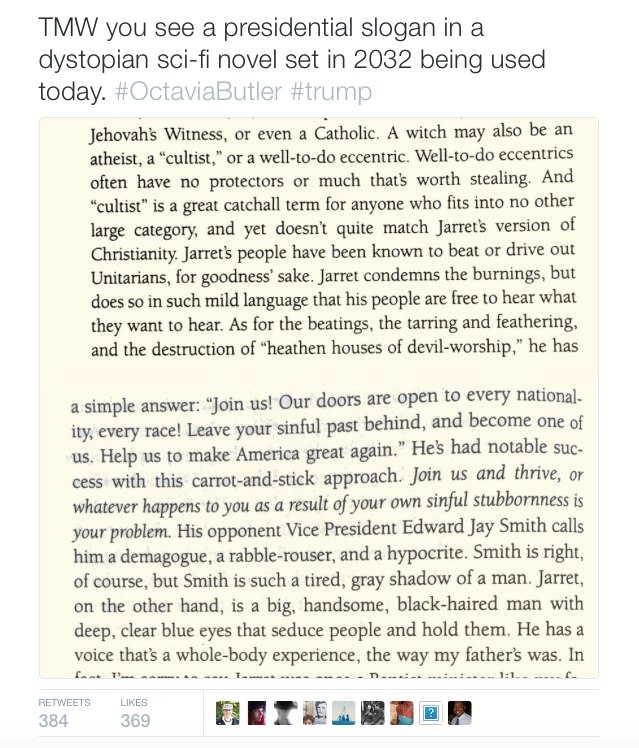
Though Trump has trademarked it, the slogan did non originate with him, nor even with Butler'southward Jarret character—the 1980 Reagan-Bush entrada used information technology, every bit Matt Taibbi pointed out Rolling Rock terminal yr. (Historians take fifty-fifty shown that another of Trump's slogans, "America Starting time," was used by Charles Lindbergh and "Nazi-friendly Americans in the 1930s.") Over again, proto-Trumpism has been in the zeitgeist for a long fourth dimension. While Butler may have used "Brand American Great Over again" from her memory of Reagan's first entrada, the way her grapheme employs it speaks to our moment for a number of reasons.
Information technology'due south true that Senator Jarret differs from Trump in some significant ways: "Jarret's beef is with Canada instead of Mexico," writes Fusion, and "instead of business apprehending every bit his principal credential, religion is Jarret'due south stump. He's the head of a group chosen Christian America, which is intolerant of other religious views, and whose supporters burn 'witches'—significant Muslims, Jews, Hindus and Buddhists—at the stake." Our current candidate may accept co-opted the religious right, only he doesn't speak their linguistic communication at all. Notwithstanding, he has made promises that requite secularists and non-Christians chills, and religious intolerance has formed the backbone of his campaign and of the rhetoric that has driven his party to the far right.
Jarret and the fanaticism he inspires become central the novel's story, but the crucial groundwork in Butler's 1998 depiction of a post-apocalyptic 2032 are the weather she identifies equally giving rise to the Senator's rule (and which she described in the commencement book, Parable of the Sower). In Talents, the narrator's begetter Taylor Franklin Bankole writes,
I have read that the period of upheaval that journalists have begun to refer to as "the Apocalypse" or more than normally, more bitterly, "the Pox" lasted from 2015 through 2030—a decade and a half of chaos…. I have besides read that the Pox was caused past accidentally coinciding climatic, economic, and sociological crises. It would be more than honest to say that the Pox was caused by our own refusal to deal with obvious problems in those areas. We caused the problems: then nosotros sat and watched as they grew into crises.
In Butler's fiction, the rising of Senator Jarret and his mobs is an event of the same kinds of impending crises we face at present, and that far too many of our leaders dutifully ignore as they stage increasingly acrimonious and baroque forms of political theater. Butler'south indirect warning to us in Parable of the Talents may be less about the demagogic leader and his cult—though they pose the most dire existential threat in the book—than about the causes and conditions that created "the Pox," the kind of social collapse that Kurt Vonnegut warned of x years before Butler in his time-capsule letter to the people of 2088, vaguely identifying similar kinds of "climatic, economic, and sociological" crises to come. Would that we could abandon empty spectacle and heed these Cassandras of the near futurity.
via The Huffington Post
Related Content:
In 1988, Kurt Vonnegut Writes a Letter to People Living in 2088, Giving 7 Pieces of Communication
Isaac Asimov Predicts in 1964 What the World Will Look Like Today
Noam Chomsky on Whether the Ascent of Trump Resembles the Rise of Fascism in 1930s Deutschland
Josh Jones is a writer and musician based in Durham, NC. Follow him at @jdmagness
Source: https://www.openculture.com/2016/07/octavia-butlers-1998-dystopian-novel-features-a-fascistic-presidential-candidate-who-promises-to-make-america-great-again.html
0 Response to "Make America Great Again Cattle Brand"
Post a Comment